


After more than a decade of persistent struggle for justice, Ms. Tran To Nga's lawsuit against American chemical companies has seen new positive signs. Developments at the French Court of Cassation (which functions like the Supreme Court of Appeal in many other countries) not only bring hope to Nga personally but also for the struggle for justice of millions of Agent Orange victims in Vietnam.
On June 16, 2026, the French Court of Cassation held a public hearing to consider the appeal related to the case. Prior to this, a noteworthy announcement in the French Senate attracted international attention. According to the legal team accompanying Nga, the representative of the Public Prosecutor's Office alongside the Court of Cassation has requested the annulment of the previous ruling by the Paris Court of Appeal – a ruling that dismissed the case on the grounds that the American chemical companies are entitled to jurisdictional immunity.
This is seen as a positive sign because, for the first time in the years-long litigation process, the prosecution's position has sided with the plaintiff on the core legal issue of the case. According to Nga's lawyers, the most important issue the Court of Cassation needs to resolve is whether the chemical companies that produced and supplied Agent Orange/dioxin to the US military engaged in normal commercial activities or carried out a mission for the US government and military. If their operations are proved to be commercial activity, they would not be able to invoke jurisdictional immunity to avoid being held accountable in court.
Attorney Bertrand Repolt and the lawyers defending Nga argue that the chemical companies being sued are private businesses operating for profit. They produced and traded the “defoliants” before, during, and after Vietnam War; and they completely controlled the production process. Fulfilling orders from the US government does not mean they became representatives or enforcers of US state sovereignty.
If the Court of Cassation accepts this argument and overturns the Paris Court of Appeal's ruling, the case will be returned to another panel for review. In that case, for the first time in many years, the parties will have the opportunity to debate the core issue of the lawsuit: the responsibility of the chemical corporations in the production and supply of toxic chemicals used by the US military in the Vietnam War; the level of toxicity of Agent Orange/dioxin and the link between dioxin exposure and the diseases and deformities suffered by the victims.

Ms. Tran To Nga with her two lawyers, Paul Mathonnet (right) and Bertrand Repolt, after the hearing at the French Court of Cassation (Photo: VNA)
Speaking to the press after the trial, Mr. Paul Mathonnet, the lawyer defending Nga, said that “the issue raised in this case concerns not only Nga but also represents the right to access justice for all victims”. The significance of the lawsuit, therefore, goes far beyond her personal life. This is a struggle for justice for Vietnamese Agent Orange victims, establishing the responsibility of American companies for the consequences caused by their products, even when those products were supplied under contract with the government and military. The outcome of this case could set an important legal precedent for similar lawsuits around the world concerning corporate liability and human rights.
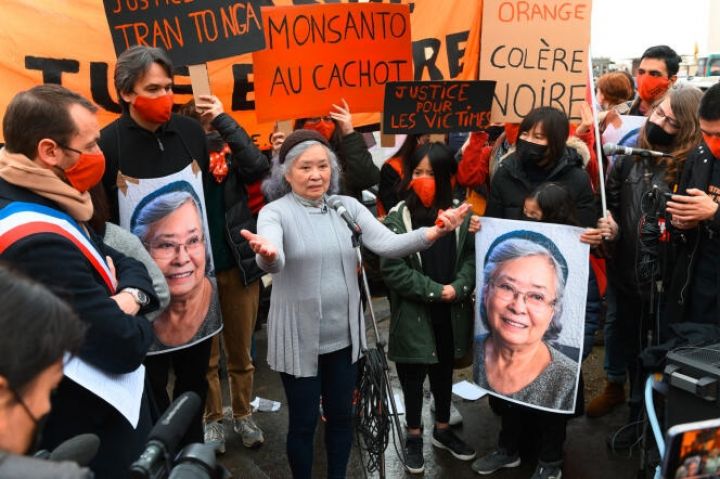
Speaking at press conferences before and after the trial, Nga repeatedly affirmed that her goal was not merely personal gain but to seek justice for millions of victims of Agent Orange in Vietnam. Despite being 85 years old, she remained determined to pursue the lawsuit to the end. She also raised a poignant question for American chemical corporations that continue to deny the toxicity of Agent Orange containing dioxin, while the US government has spent hundreds of millions of dollars compensating American veterans exposed to the toxic substance and acknowledging many related illnesses. According to her, anyone who witnesses the lives of families with generations suffering from deformities and illnesses due to Agent Orange/dioxin in Vietnam can understand the suffering of the victims.
Nga's struggle over the years has also contributed to raising international awareness of the serious consequences of chemical toxins. Many social, environmental, human rights, and political organizations in France have actively supported her. Over 60 organizations have participated in the campaign to support the lawsuit. In particular, the Belgian Parliament's adoption of a resolution supporting Vietnamese victims of Agent Orange and the inauguration of a memorial to Agent Orange victims in Paris in April 2026 are considered significant milestones in the international solidarity movement with Vietnamese Agent Orange victims.
At a press conference in the French Senate, many senators also emphasized that the consequences of Agent Orange are still evident more than half a century after the end of the war in Vietnam. Millions of hectares of forest have been destroyed; dioxin remains in the environment in many areas; millions of Vietnamese people and future generations continue to suffer severe health and life impacts.
The French Court of Cassation's ruling is expected to be announced on September 16, 2026. Regardless of the outcome, Nga's lawsuit has become a symbol of the yearning for justice, the unwavering will of Vietnamese Agent Orange victims, and the growing international community's support for this just and humane struggle.
More than a lawsuit, it is a journey to preserve historical truth, protect justice, and affirm that the suffering of Agent Orange victims cannot be forgotten. The lawsuit is also a warning about the severe and long-lasting consequences of chemical weapons in war. It reminds us not to let similar chemical warfare disasters recur elsewhere in the world.
Manh Dung

_thumb_720.jpg)




_thumb_720.jpg)







.jpg)






Comment